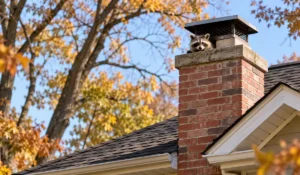
If squirrels seem unusually interested in your roof this fall, there is usually something drawing them there. What attracts squirrels to a roof in fall is usually a combination of easy access, nearby food, protected shelter, and potential entry points.
As temperatures cool and shelter becomes more valuable, a roof can provide access to protected spaces, travel routes, nearby food sources, and—if an opening exists—a potential way into the attic.
The important point is that the roof may only be part of the journey. Repeated rooftop activity can be an early sign that squirrels are investigating the structure rather than simply passing through.
What Is Your Fall Roof Attraction Score?
Start with the exterior of your own home.
How many of these conditions apply?
Rather than treating the total as a formal risk score, use it as a practical self-check.
0–1 conditions: Few obvious access features are present, but occasional roof activity is still possible.
2–3 conditions: Several features may make the roof easier for squirrels to reach or investigate.
4 or more conditions: Multiple access and attraction factors are present, making a closer exterior inspection worthwhile.
No checklist can confirm an attic problem by itself. What it can do is show whether your property gives squirrels convenient reasons to keep returning.
What Attracts Squirrels to Roofs in October?
Food is only part of the story.
During fall, squirrels spend considerable time searching for and storing food, but they are also looking for secure places that can help them through colder conditions. Protected nesting areas, familiar travel routes, and shelter from weather and predators all become valuable.
That makes roofs especially useful.
A squirrel may use the roof as:
- A travel corridor
- A lookout point
- A route between trees and structures
- Access to gutters or roof intersections
- A place to investigate vents, soffits, and fascia
- A stepping stone toward an attic or other protected space
The roof is not always the destination.
If a squirrel finds a vulnerable opening, the attic can offer a much more protected environment than the exposed roofline.
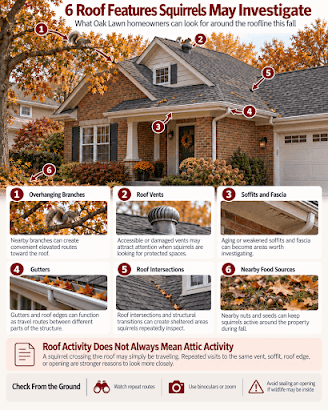
The Most Common Ways Squirrels Reach a Roof
Squirrels are agile climbers, and a home does not need a tree touching the shingles for them to reach the roof.
Tree-to-Roof Routes
Branches that extend over or near the structure can create one of the easiest pathways onto a roof.
Even when branches do not physically touch the house, nearby trees may still give squirrels access to fences, garages, sheds, or other elevated surfaces that bring them closer.
Utility Lines
Overhead lines can sometimes function as travel routes between poles, trees, and structures.
Homeowners should not attempt to alter utility lines themselves. If a line appears to contribute to wildlife access, the safer approach is to discuss the situation with the appropriate utility provider or wildlife professional.
Fence-to-Garage-to-Roof Routes
A squirrel does not necessarily travel directly from the ground to the house.
It may move from a fence to a shed, then onto a detached garage, and finally toward the main roof. Suburban properties with several connected or closely spaced structures can unintentionally create a series of elevated pathways.
Pergolas, Sheds, and Decorative Structures
Pergolas, arbors, trellises, sheds, and similar structures can also make climbing easier when they sit close to the home.
For Oak Lawn homeowners, it is worth looking beyond the roof itself. On properties with mature trees, detached garages, fences, or dense landscaping, the entire yard can form a connected route toward the house.
Why Some Roofs Become Repeat Targets
Understanding what attracts squirrels back to the same roof can help explain why some homes become repeat targets.
Wildlife often repeats routes that provide dependable access to food, shelter, or protected travel. Once a squirrel has learned that a particular tree, fence, garage, or roofline is easy to navigate, it may continue using that path.
Previous nesting activity can also matter.
If an earlier wildlife problem left behind an unrepaired gap, damaged vent, weakened soffit, or accessible opening, the structure may remain vulnerable even after the animal is gone.
That is why simply removing a squirrel does not necessarily solve the underlying problem.
Long-term prevention depends on understanding:
- How the animal reached the roof
- What encouraged it to return
- Whether it found an entry point
- Whether that opening can be safely corrected
- Whether other wildlife could use the same route
Is It a Squirrel—or Something Else?
Not every sound above the ceiling comes from a squirrel.
Timing, sound patterns, visible damage, and direct sightings can provide useful clues, although a professional inspection may still be needed for confirmation.
| Sign | Squirrel | Raccoon | Mice or Rats |
|---|---|---|---|
| Activity during daylight | Common | Possible, though often more active at night | Possible, but many are more active after dark |
| Running or scrambling near roofline | Common | Possible and often heavier-sounding | Less typical on an exterior roof |
| Large or forceful entry damage | Less typical | More likely | Uncommon |
| Daytime roof sightings | Common | Possible | Less common |
| Gnawing around smaller openings | Possible | Less characteristic | Common |
| Activity inside attic spaces | Possible | Possible | Possible |
Sound alone cannot reliably identify the animal. A heavier thump, scratching behind a wall, or movement at night may point toward a different pest or wildlife issue.
This is one reason a roofline inspection can be more useful than trying to identify the animal based only on noise.
The Hidden Costs of Ignoring Repeated Roof Activity
A squirrel running across the roof may seem harmless.
The concern begins when repeated activity turns into chewing, nesting, or entry into protected areas of the home.
Possible problems can include:
- Damaged soffits or fascia
- Chewed vent covers
- Disturbed insulation
- Nesting material in attic spaces
- Damage around roof penetrations
- Chewed electrical wiring
- Openings that later allow other pests or wildlife inside
Damaged wiring can create an electrical safety concern, while disturbed insulation or open exterior gaps may affect the home’s ability to retain conditioned air.
Not every squirrel sighting leads to property damage. But repeated activity around the same portion of the roof deserves more attention than an occasional animal simply passing through.
What Wildlife Specialists Look for During a Roof Inspection
A wildlife inspection should answer more than, “Is there a squirrel here right now?”
The more useful questions are:
Where is the animal traveling?
Branches, utility routes, fences, garages, and roof intersections can reveal the path.
Where could it get inside?
Inspectors may look at vents, soffits, fascia, roof edges, flashing areas, and other structural transitions.
Is there evidence of chewing?
Gnaw marks can help distinguish active investigation from ordinary rooftop travel.
Has nesting already begun?
Insulation disturbance, nesting material, droppings, or repeated interior sounds can help identify possible attic activity.
Could the same opening admit another animal?
A vulnerability used by a squirrel may also create an opportunity for rodents or other wildlife.
Homeowners looking for a pest inspection in Oak Lawn after hearing unexplained roof or attic noises should mention where and when the sounds occur. Those details can help narrow the inspection area
Removal Alone Does Not Prevent Re-Entry
Getting an animal out of an attic solves only one part of the problem.
If the access route remains available, the same squirrel—or another animal—may investigate it again.
Effective wildlife removal therefore needs to consider both the animal and the structure.
Depending on the property and the situation, that can involve:
- Confirming the species involved
- Identifying active entry points
- Determining whether young animals may be present
- Removing wildlife using appropriate methods
- Correcting accessible entry points when appropriate
- Reducing conditions that encourage repeated access
- Monitoring for continued activity
For homeowners considering squirrel removal in Oak Lawn, the useful question is not simply how quickly the animal can be removed. It is whether the reason it entered can also be identified.
The same principle applies to attic wildlife removal. An attic should be evaluated as part of the building rather than as an isolated space.
If humane handling is an important consideration for your household, ask the wildlife professional what removal or exclusion methods are appropriate for the species and circumstances. The goal should be to resolve the wildlife problem safely while reducing the chance of repeated entry.
Could Squirrels Be Revealing a Bigger Property Problem?
Sometimes the squirrel is not the only issue.
Repeated wildlife activity can draw attention to conditions that were already developing around the home.
An animal investigating the roof may reveal:
- A deteriorating soffit
- A damaged vent cover
- A loose exterior component
- A roofline gap
- An opening around an addition or garage
- A route that rodents could potentially use
- Areas that need maintenance regardless of wildlife activity
That makes wildlife activity useful information.
The animal did not necessarily cause every weakness it discovers. Sometimes it simply exposes a structural vulnerability that homeowners had not noticed.
If other signs are present—such as rodent droppings, chewing, nighttime wall noises, or insect activity—a broader pest inspection may make sense alongside the wildlife assessment.
A Simple Fall Roof Check for Oak Lawn Homeowners
You do not need to climb onto the roof to perform a useful follow-up check. From the ground, note whether squirrels repeatedly visit the same roof edge, vent, soffit, garage connection, or tree route. Binoculars or a zoom camera can help you inspect higher areas without using a ladder. If you suspect wildlife is already inside, avoid sealing an opening until the situation has been assessed
Keep a Rooftop Visitor From Becoming an Attic Problem
A squirrel on the roof does not always mean there is an infestation inside. Repeated visits to the same vent, soffit, or roof edge, however, can be an early warning that the animal has found something worth investigating.
If you are seeing squirrels repeatedly on your Oak Lawn roof or hearing activity in the attic, A1 Pest Masters can inspect likely access points, evaluate signs of wildlife activity, and recommend next steps based on the property.